 Anthony Roux
FROM THE WORKSHOP AN ANTHONY ROUX STORY
HUMAN IMAGINATION × ARTIFICIAL INTELLIGENCE
The ideas are human.
The workshop just got an upgrade.
WE USED TO WATCH
THIS IN THE MOVIES.
NOW WE’RE AT
THE WORKBENCH.
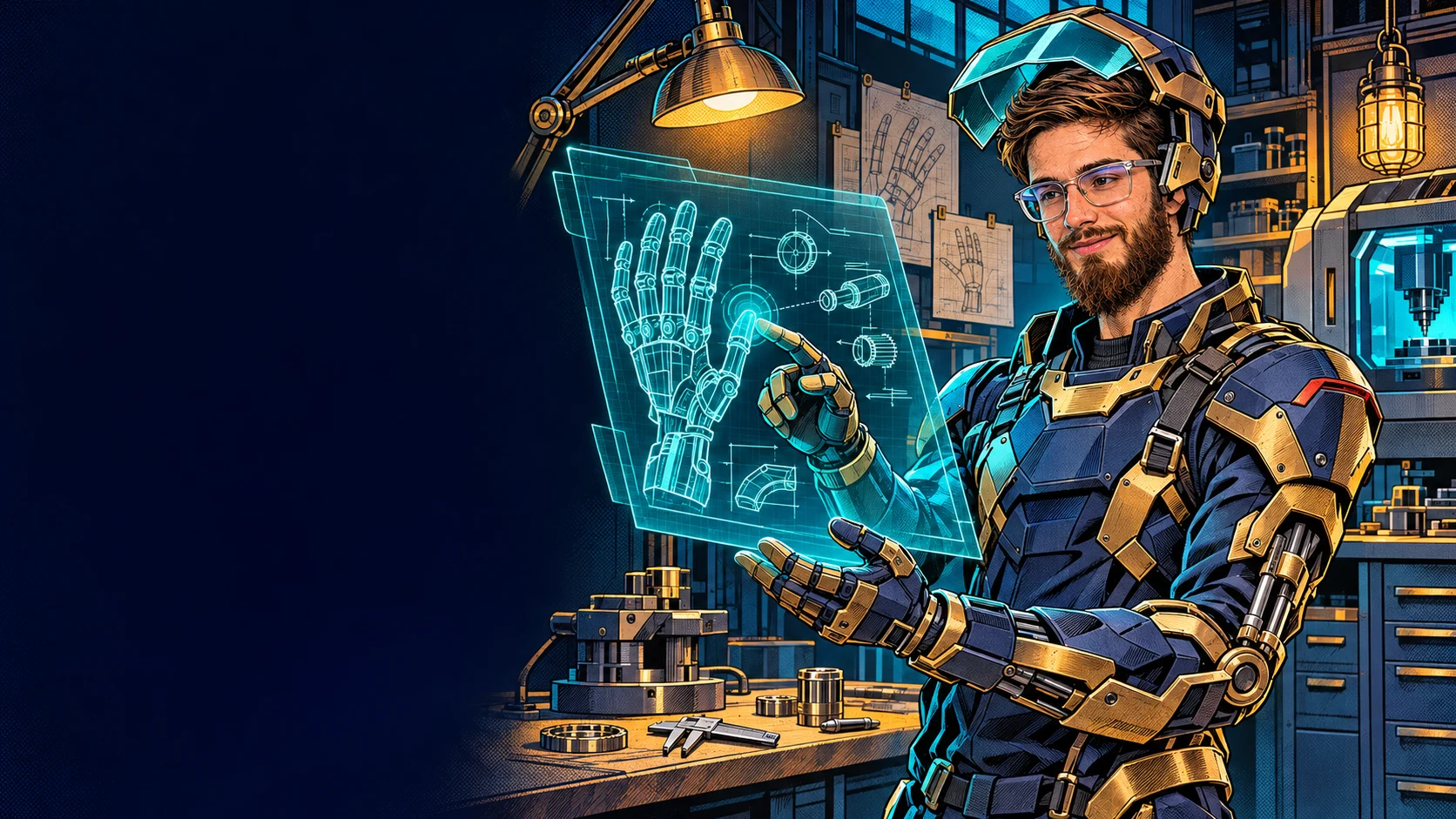
I keep coming back to the same comparison when I explain how I work with AI: Iron Man and his workshop.
A person has an idea. A system helps turn it into something they can inspect, test and improve. The person spots what is wrong, changes direction and asks for another version. The conversation becomes part of the build.
That is what I mean when I say we’ve entered the Iron Man era. It is a metaphor for a change I can feel in my own work: the distance between imagining something and making a first version has become smaller.
We still need experience. We still need to learn. And we absolutely still need to check what comes back. But the workshop is starting to feel a lot more interesting.
What does good human–AI collaboration actually look like?
An IT game, a network investigation and a logo that needed to be right.
A repeatable way to imagine, build, test, correct and improve.
START WITH THE PERSON
THE SUIT DIDN’T
INVENT THE ENGINEER.
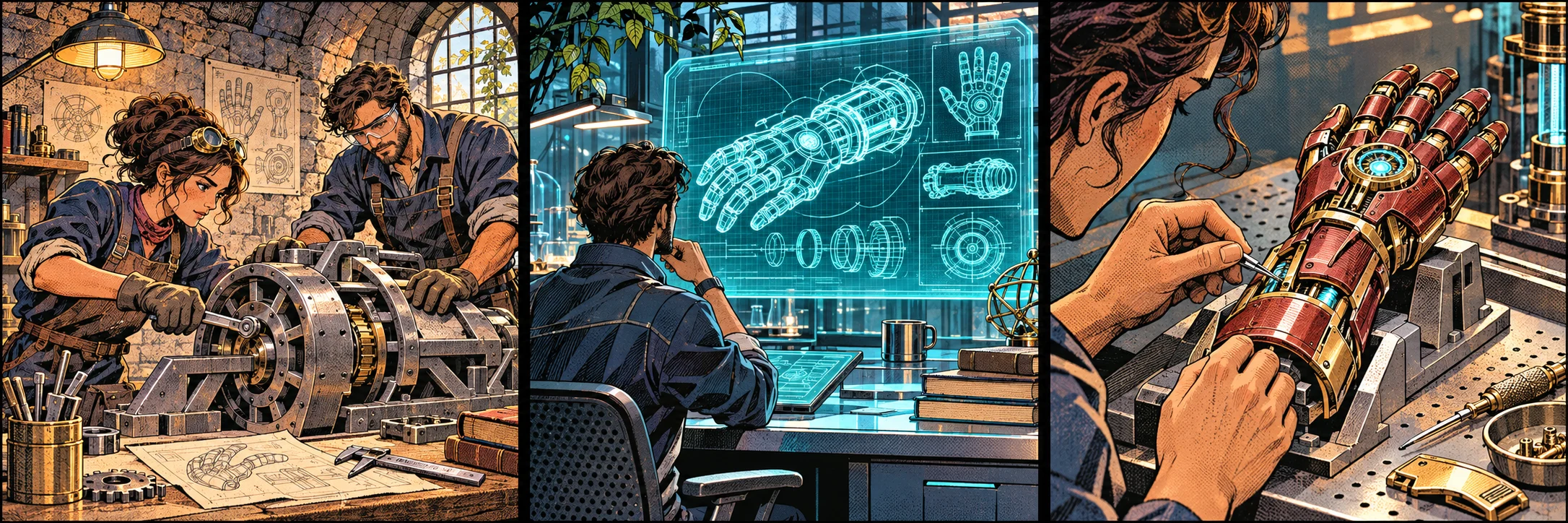
In the first Iron Man film, Tony builds the original suit in a cave with Yinsen’s help. The rough design is a product of knowledge, improvisation and human collaboration under extraordinary constraints.
Later, the workshop is better equipped. JARVIS helps with the work. Designs can be explored, components refined and ideas tested. Tony is still making decisions about what the suit should become.
That is the part of the analogy I care about. Better assistance gives you more room to work on the idea itself: how it functions, what needs changing and whether the result meets your standard.
You do not have to arrive knowing everything. A useful assistant can explain something unfamiliar or propose an approach you had not considered. Learning can happen while you build. Staying engaged is what makes the difference.
Original comic illustrations inspired by the film analogy. This is an independent editorial, unaffiliated with Marvel.
THE CONVERSATION IS PART OF THE CRAFT
THINK. BUILD.
TEST. THINK AGAIN.
Working in sync means exchanging context, challenging assumptions and improving the next attempt. Watch how the human contribution changes the direction.
Make the IT work feel real.
A technician should investigate symptoms, make a diagnosis, verify a repair and live with the business consequences.
Turn the idea into a system.
Break the loop into ticket data, device states, player actions and feedback that a prototype can represent.
The human defines what a useful result should feel like.
Faster is useful.
A first draft gives you something concrete to react to. Code, an outline or a design can move the conversation beyond a vague idea. AI can contribute substantial work, and a useful suggestion can also come from the system.
Accuracy needs evidence.
A confident answer can still assume the wrong platform or overlook a requirement. Speed only helps if you use some of that saved time to inspect, test and understand the result.
CASE FILE 01 / GAME DEVELOPMENT
BUILDING
ROOT//ACCESS.
A WORKING PROTOTYPE, AN EVOLVING IDEA
“The internet
is down.”
01 Inspect the symptoms
02 Find the cause
03 Repair & verify
04 Document & close
ROOT//ACCESS is the IT game I am developing: a technician career where support tickets exist inside a wider world of clients, time, equipment, money and reputation.
The interesting part is translating experience into something playable. A support case should reward investigation. A green link light should not solve the whole mystery. Closing a ticket should mean the player has evidence that the service works.
AI helps turn those ideas into mechanics, code and prototypes. I bring the context that makes the work recognisable: how a technician investigates, which details matter and where a shortcut would make the simulation feel wrong.
The wider ambition includes choices beyond the ticket itself. Spending time at an IT convention might offer an opportunity while also costing time that could have gone into paid work. Those are design questions we can explore and test.
The game is still in development. A prototype proves only what it actually does. A convincing description of a system is not evidence that the full system is built.
The direction, the IT context and the standard the experience needs to meet.
AI’S CONTRIBUTIONImplementation help, alternatives and a quicker route to something we can inspect.
NETWORK TROUBLESHOOTING
ONE WRONG
ASSUMPTION.
In a DNS investigation, I supplied test results and the AI initially approached the problem as though the device were running Windows DNS. I corrected the platform: it was a MikroTik.
Identify the actual device before choosing the next checks.
That changes the relevant interfaces and diagnostic path. AI can help organise evidence and suggest a next test; the technician knows the environment and checks whether the suggestion fits.
The lesson is about the investigation. A platform correction alone does not establish the root cause or prove a fix.
CREATIVE DIRECTION
THE LETTERS
ARE THE CUBE.
For the ICS logo concept, my requirement was specific: the letters themselves had to form the cube. Placing letters inside a separate cube missed the idea.
Check the geometry against the brief, then preserve the approved direction.
AI helped visualise possibilities. I assessed the letter shapes, orientation, gaps and colours. The cyan I and white C and S needed to read correctly as both letters and a shape.
Recognising which version fulfils the idea is a contribution. So is knowing when to stop changing the part that already works.
YOU DO NOT NEED A FLYING SUIT TO START
GIVE THE NEXT IDEA
A BETTER BRIEF.
Choose one small thing you want to build or understand. Describe a result you could actually check. Then work through this loop.
- 01
Imagine
Name the outcome, the person it helps and the problem it should solve.
- 02
Build
Ask for the smallest useful first version. Make assumptions visible.
- 03
Test
Try it against a real example. Observe what happened.
- 04
Correct
Explain the mismatch. Supply missing context or a counterexample.
- 05
Improve
Change what the evidence supports, then check the next version.
YOUR NEXT BUILD STARTS HERE
A small plan.
A useful first step.
Turn your idea into a brief you can take into your next AI conversation. Everything you type stays in this page; it is not sent to a server.
Download the workshop worksheet (PDF) ↓Your workshop brief
Keep the steering wheel. Ask why a suggestion fits, check facts against relevant sources and learn enough about the result to question it. For real client work, use only information and systems you are authorised to use.
A LITTLE OPTIMISM. SOME COMMON SENSE.
THE FUTURE
IS ON THE
WORKBENCH.
I like the fact that an idea can now become something I can examine much sooner. That gives me more opportunities to notice a problem, learn something and improve the work.
It also makes judgment more visible. When generating another version is easy, choosing a useful direction matters. So does recognising when the answer is missing the point.
The Iron Man comparison is a hopeful one. Current AI is not the fictional JARVIS, and the films are not a prediction of where this technology will lead. The future is still unfolding around us.
For now, I want to use the tools to build things worth making, understand more of the work and keep improving my own contribution.
The workshop is open.
What are you going to build?

THE PERSON BEHIND THE WORKSHOP
ANTHONY ROUX.
I’m a South African technical lead working with business IT, networks and infrastructure. This is where I share practical lessons, projects in progress and the ideas I am exploring along the way.
Your workshop worksheet
Plan a small build, record assumptions and define a test before you start.
02 / ANOTHER COMIC-BOOK DETOUROne bullet. A whole network.
Follow my Fortnite shot from the mouse to the server.
Still on the workbench.
A companion video has not been released for this story. Follow the channel for future projects.
Visit Anthony Roux IT ↗Behind this story: sources & illustration notes
This is a personal perspective on collaboration, not a benchmark of any AI product. ROOT//ACCESS is in development. The network and logo examples come from my project discussions; the lab dialogue is an illustrative reconstruction, not a verbatim transcript.
The film analogy refers to Iron Man (2008). Tony builds the first suit with Yinsen’s help and works with JARVIS on later designs. The illustrations are AI-generated artwork inspired by that analogy; they are not film stills. Iron Man, JARVIS and Ultron are Marvel characters. This independent article is not endorsed by Marvel.